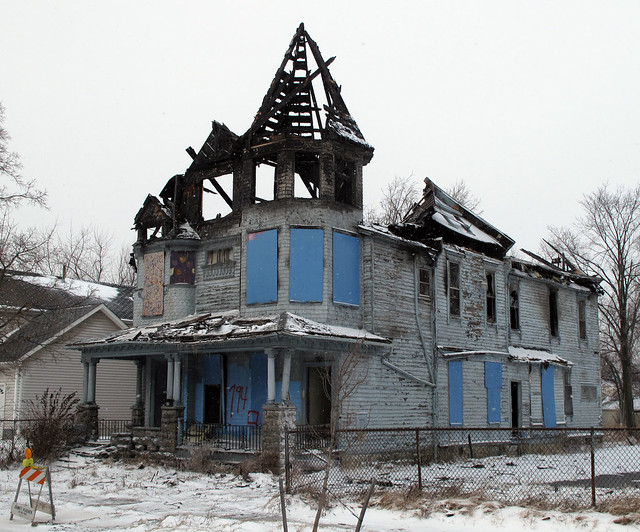
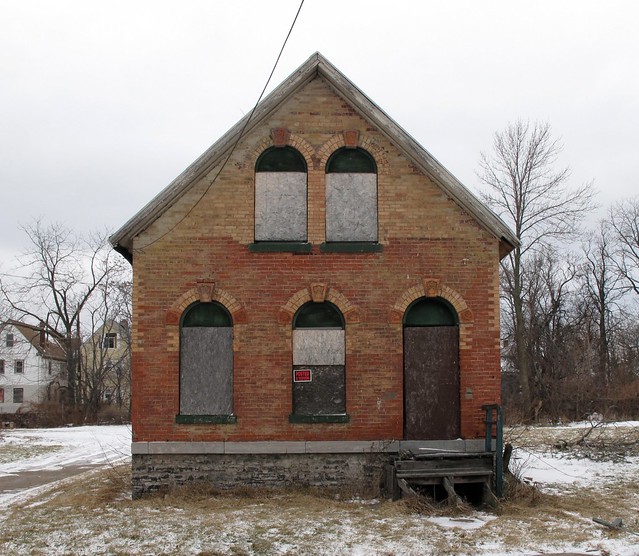
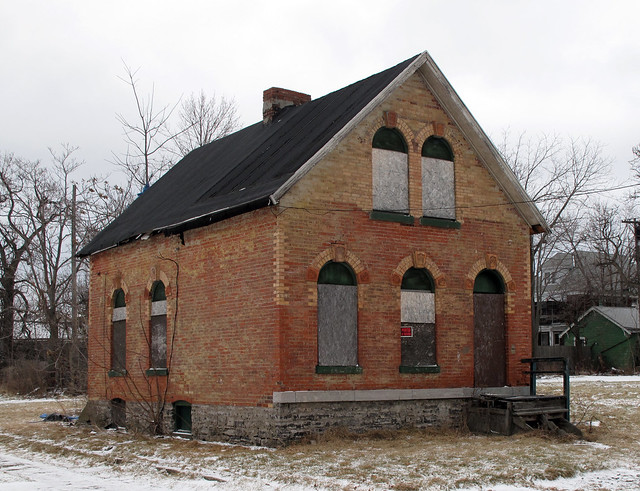
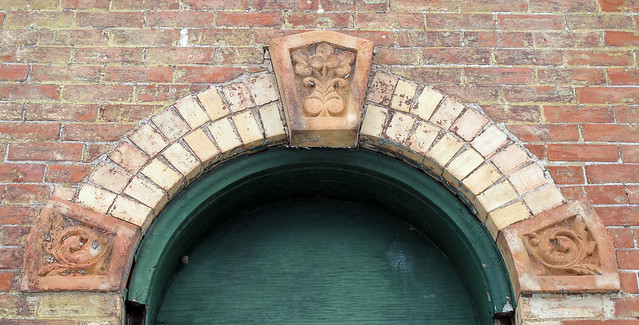
City Abanonded: 16 Harwood Place - Lyth Cottage
7 Comments Published by fixBuffalo on 1/31/2010 at 10:04 AM.An embarrassment of riches. Like a number of other historic cities in the northeast and mid-west that have lost substantial population, Buffalo has a very large stock of historic resources relative to its population. The number of historic structures exceeds the number the population and economy will be able to rehabilitate and reuse in the foreseeable future. This places great pressure on the preservation community and the city to determine what it is most important to preserve and how to do it.
building index • fixBuffalo flickr • creative class • shrinking cities • americansuburbX
spacing toronto • infrastructurist • inhabitat
building index • fixBuffalo flickr • creative class • shrinking cities • americansuburbX
spacing toronto • infrastructurist • inhabitat
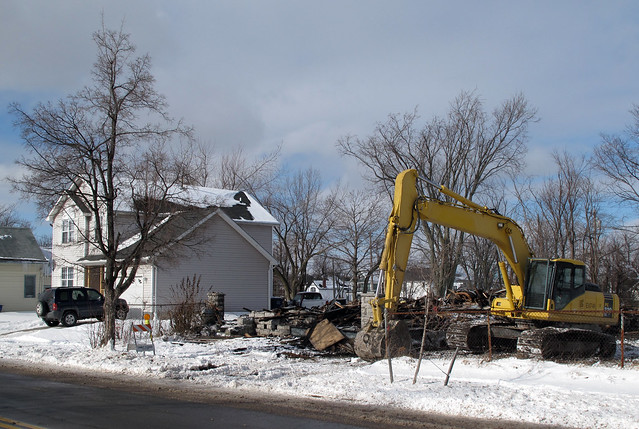
After numerous fundraisers and work days the center piece of this initiative is now gone. An arsonist set 194 East Utica on fire early this morning. In a widely circulated email this morning Rod pointed to the changed funding climate that's held up rehab plans on this part of the Queen City Farm project.
In a New York Times article - Vacant Properties: Scourge of a Beaten Down Buffalo, September 2007 - I suggested a new system of triage, a way of prioritizing the architecturally and historically significant structures, as everything can not be saved. This would be a first step and certainly help mitigate what's clearly a pattern of loss moving forward. After the identification of cool City-owned property is completed, mothballing is the second.
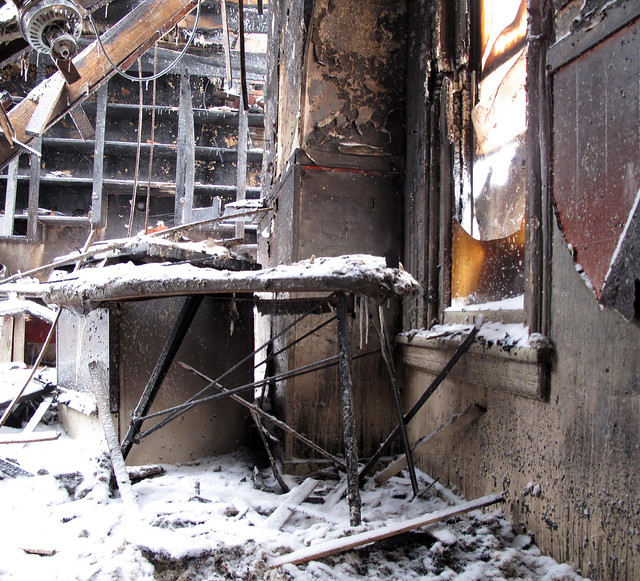
The alternative - current plan?! - remains ad hoc at best and consists of expensive emergency demolitions. Planning and strategic thinking about these places by preservation organizations and City Hall is non-strategic, ad hoc and sadly reactionary. According to City Hall, late this morning, an emergency demolition order has not been signed. It will be ordered in the next few days as this fire ravaged hulk sits directly across the street from the temporary home of City Honors High School. The demolition of 194 East Utica, planned by the City in 2006, would have cost $22k. Emergency demolitions always cost more.
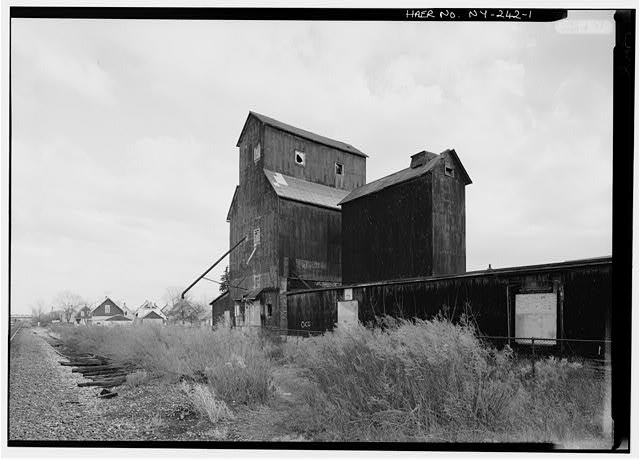
The more sensible alternative, systematic and strategic identification and mothballing, could easily take advantage of these systems - Vacant Property Security - that may prevent the arsonist from entering the structure. A plan that requires everyone pushing and pulling in the same direction would preserve these sensitive structures for future use. Some very cool City-owned places such as the Woodlawn Row Houses and the Wollenberg Grain Elevator once burned are gone forever.
See - Queen City Farm video and the QCF archive for additional pics and posts.
building index • fixBuffalo flickr • creative class • shrinking cities • americansuburbX
spacing toronto • infrastructurist • inhabitat
Here's the first of six parts.
building index • fixBuffalo flickr • creative class • shrinking cities • americansuburbX
spacing toronto • infrastructurist • inhabitat
The Youngstown Solution
Masten Councilman Demone Smith looks at a radical solution: unbuilding the city, landbanking neighborhoods
Last week, Masten District Councilman submitted into the legislative record two articles about Youngstown, Ohio’s efforts to manage its shrinking population. Buffalo, Smith told his fellow councilmembers, could learn from Youngstown’s example.
Youngstown, like Buffalo, has lost more than half its population since World War II, dwindling from a peak of 170,000 to just 80,000. The city’s leadership has decided to accept the likelihood of further population loss and entered into a partnership with academics at Youngstown State University to explore methods of managing the decline. The resulting plan, called Youngstown 2010, includes a radical concession to the realities faced by economically depressed cities in the Northeast with populations that are growing older and poorer: Some neighborhoods, the plan says, are (at least temporarily) beyond salvaging. So governments should stop investing in infrastructure in those neighborhoods and encourage residents to move into more viable sections of the city. The decrepit neighborhoods should be landbanked, the study says—cleared and turned into greenspace until the city’s population and tax base rebound.
Way back in 2002, renowned urban planner Anton Nelessen offered the same advice to Buffalo. In an interview with Artvoice, Nelessen said, “Buffalo needs to shrink. The whole urban ecostructure needs to shrink. Where do you choose what shrinks and what doesn’t shrink? What do you keep and what do you dispose of? That becomes significant not only to localized planning but to regional planning.”
Nelessen dismissed as sentimental and inhumane the notion that people living in distressed neighborhoods on Buffalo’s East Side might be angry at a government that planned those neighborhoods into obsolescence. “There is no neighborhood anymore,” he said. “It’s ragged teeth of buildings here and there, lots of people on drugs, little kids barely surviving on the streets. If that’s what we want as a country and a culture, that’s fine. But if it’s not what we want, then something needs to be done. It’s time we stopped pussy-footing around and said, ‘We’ve got to begin to talk about planning policies.’ Sprawl has devastated most cities, and the Buffalo area, because it is both losing population and has lots of housing being built on the periphery, is in an advanced state of sprawl.”
Demone Smith represents some of the poorest and most neglected areas of the city. If he seriously is putting this idea on the table—the idea that Buffalo ought to let some of those neighborhoods fade away rather than continue to invest in them—then maybe we ought to pick it up and examine it.
building index • fixBuffalo flickr • creative class • shrinking cities • americansuburbX
spacing toronto • infrastructurist • inhabitat
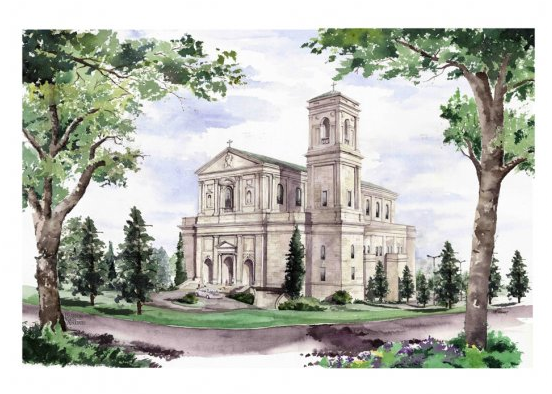
Could the architects who designed St. Gerard's, the workers who built it and the parishioners who paid for the church ever imagine such a fate? Such sacred structures were made to endure...to last for hundreds of years.
building index • fixBuffalo flickr • creative class • shrinking cities • americansuburbX
spacing toronto • infrastructurist • inhabitat
Lourdes on Main Street - For Sale, again
9 Comments Published by fixBuffalo on 1/08/2010 at 1:49 PM.This view, from the City's Ellicott Street parking ramp shows the missing south facing window. The boards covering the front window opening - no stained glass here - were missing as of yesterday.
Fred Occhino from Hunt Real Estate has recently listed 1115 Main Street at $199K. In a phone conversation yesterday afternoon Fred said the owner may consider holding a mortgage. With the staggering level of investment happening in the Medical Corridor only blocks away with the construction of the Kaleida/UB Global Vascular Institute - $500M - and the City Honors reconstruction - $40M - two blocks east, the future of Lourdes remains uncertain. Between Downtown and Ferry Street Lourdes is one of the last boarded buildings on Main Street, for now.
building index • fixBuffalo flickr • creative class • shrinking cities • americansuburbX
spacing toronto • infrastructurist • inhabitat

A new year, a new face for the Hydraulics blog! The new, rebranded Hydraulics Press represents the evolution of the blog as a medium for news and stories about Buffalo's earliest industrial district, the Hydraulics.
2010 promises some pretty amazing developments in the neighborhood - some ongoing, some yet to be announced. It was time, now more than year after the blog's founding, to tweak the brand of the site and switch up its mission. The Hydraulics Press, at www.Hydraulicspress.com, reflects the evolving orientation of the site as a news source and periodical on the neighborhood, now no longer merely confined to archival histories. It also represents a pithy play on words - it sounds like a newspaper, such as the Grand Rapids Press, and its name derives from the term "hydraulic press," the hydraulic mechanism for applying a large lifting or compressive force, the water-based equivalent of a mechanical lever. Creative, eh? I thought so!
I'm excited about the continuing contribution the site will play in telling the ongoing story of the Hydraulics. Here's to a new decade, and to the new Hydraulics Press!
building index • fixBuffalo flickr • creative class • shrinking cities • americansuburbX
spacing toronto • infrastructurist • inhabitat
ATTENTION: Architects, Green Builders, Artists & Designers
Buffalo ReUse is assembling a working group to brainstorm, research, and explore the feasibility of a new, innovative building and reuse idea. Imagine real Green Housing and Neighborhoods in Buffalo. If you have an interest in green building, architectural design, interior design--particularly with reused building materials, please join us. We also need folks with knowledge of alternative heating systems, alternative building materials, and residential building codes.We welcome those of you who have an interest in brainstorming and working on a very out-of-the-box building reuse, rehabilitation, and eco-friendly project with a unique twist.
We will hold an introductory meeting to overview the intention of the project on Monday, January 11th at 6:30 p.m. at 158 Eaton Street.
If you are unable to attend, but would like to be included in the email group to receive updates for future meetings please send a short interest email to rehome@buffaloreuse.org
The above pic is from WebUrbanist. Make sure to check out this post about 15 creative conversion projects.
building index • fixBuffalo flickr • creative class • shrinking cities • americansuburbX
spacing toronto • infrastructurist • inhabitat
Ted grew up in Tonawanda and finished a program at UB in geography. He left the area in 1986 and completed his Masters at the University of Washington in the same field. He has worked at the National Archives since 1990 as an archivist. In a telephone conversation with Ted this afternoon he described himself as one of about 100 volunteers doing this work on a national basis - here: wiki project National Register of Historic Places. The wiki is peer reviewed.
As for my interest in Buffalo, I am a native of the city of Tonawanda. In junior high, I developed an interest in history and genealogy. My mothers family settled on the old East Side in the 1840s and lived in that area for over 100 years. From that, I have had an interest in historic buildings and the changing urban landscape. In 2008, I "discovered" the Wikipedia National Register of Historic Places project and have contributed well over 1,000 "stub" articles and over 100 photos to that effort. These have included sites in Maryland, Pennsylvania, and New York.Ted updates the Buffalo wiki on a regular basis, most recently two weeks ago, with data sifted from this site maintained by New York State's Office of Parks Recreation and Historic Preservation. Ted also maintains the Niagara County wiki.
building index • fixBuffalo flickr • creative class • shrinking cities • americansuburbX
spacing toronto • infrastructurist • inhabitat